The Encryption Trap: Server-Side vs True Zero-Knowledge
· TreeNotes Team
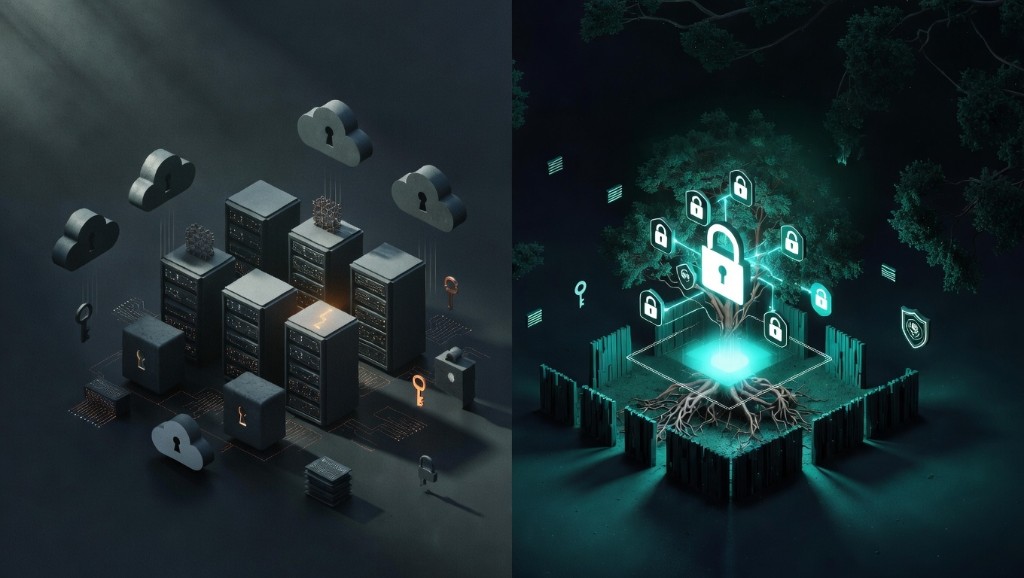
You see it everywhere: "Your data is encrypted."
At first glance, that sounds like privacy solved. Done. Safe. No worries.
But there is a quiet trap hidden in that sentence:
Encrypted by whom, and unlocked by whom?
That one detail changes everything.
Because in many products, your notes are encrypted, yes—but the provider still keeps the keys. Which means the provider can still read your data, hand it over, analyze it, or lose control of it in a breach. The lock exists, but someone else has a spare key.
At TreeNotes, we built the opposite model on purpose: true zero-knowledge encryption, where you hold the keys and we cannot read your notes at all.
This article is your plain-English guide to spotting the difference in 5 minutes.
The two worlds of "encrypted"
Most people assume encryption is one thing. In reality, there are two very different systems that often get marketed with similar words.
1) Server-side encryption (common, but limited)
Your data travels to the provider and is encrypted on their systems (or decrypted there during processing). The provider controls the keys.
That helps against some threats, like a stolen hard drive.
But it does not protect you from:
- Internal access at the provider
- Legal requests delivered to the provider
- Analytics or AI processing on readable content
- Key compromise at the provider level
In short: your data is protected from random outsiders, but not from the platform itself.
2) True zero-knowledge encryption (rare, but real privacy)
Your data is encrypted on your device before it is uploaded. The keys that can decrypt your content never live on the provider's servers in usable form.
That means the provider stores ciphertext, not readable notes.
If done correctly, this model protects your content even if:
- The server is breached
- The company is compelled to provide your stored data
- Someone inside the company tries to inspect user notes
This is the model TreeNotes uses from day one.
The comparison at a glance
Here is the practical difference, side by side.
| Privacy Criterion | Typical Server-Side Model | "Encrypted" But Provider-Readable Model | TreeNotes (True Zero-Knowledge) |
|---|---|---|---|
| Where encryption happens | Mostly on provider systems | Mixed, often decryptable on backend | On your device before upload |
| Who controls decryption keys | Provider | Provider (directly or recoverably) | You (and people you explicitly share with) |
| Can company staff read note content? | Yes, technically possible | Usually yes, technically possible | No, not technically possible |
| Can data be turned over in readable form by provider? | Often yes | Often yes | Provider only has ciphertext |
| Breach impact on note content | Potential plaintext exposure | Potential plaintext exposure | Encrypted blobs without your keys |
| "Forgot password" recovery by provider | Usually possible | Usually possible | Not possible without your key material |
| Server-side AI analysis of private content | Easy to enable | Easy to enable | Not possible on plaintext without your consent/export |
| Privacy model | Policy-based trust | Policy-based trust with encryption marketing | Cryptography-enforced privacy |
| Default security posture | Provider can unlock | Provider can unlock in many flows | Provider cannot unlock by design |
If you remember only one line, make it this:
Server-side encryption asks you to trust the company. True zero-knowledge removes that requirement.
Why this distinction matters in real life
It is tempting to treat all encryption claims as equivalent. But the day things go wrong, architecture matters more than marketing.
Scenario A: Database breach
- Server-side model: Attackers who reach key systems or decrypted paths may expose readable user content.
- TreeNotes model: Attackers get encrypted data without your local decryption keys. Your notes remain unreadable.
Scenario B: Legal pressure
- Server-side model: Provider may be required to deliver readable data because they can access it.
- TreeNotes model: We can only deliver encrypted blobs, because we do not hold your content keys.
Scenario C: "Can support quickly check your notes?"
- Server-side model: Sometimes yes. Helpful in the short term, risky long term.
- TreeNotes model: No plaintext access. Support can help with app behavior, not read your private writing.
That can feel strict, but it is exactly what real privacy looks like.
The password-reset question people always ask
When users first hear "zero-knowledge," one question always comes up:
"If you cannot read my notes, can you reset my password?"
In most server-readable systems, the answer is yes—because the provider can still unlock data.
In true zero-knowledge systems, the answer is different: password resets cannot magically recreate keys the provider never had.
That is not a flaw. That is proof of the model.
TreeNotes chooses privacy by design over convenience theater. Your private data stays private because no backdoor key exists on our side.
"But I just want something simple"
Fair. Most people are not trying to become cryptography experts. You just want to write, organize, and move on with your day.
That is exactly why this topic matters.
You should not need to study whitepapers to know whether your notes are truly private. A good privacy product should make the right architecture invisible in daily use:
- Fast editor
- Smooth syncing
- Easy sharing with people you choose
- Strong privacy protections in the background
TreeNotes is built around that balance: simple experience, serious privacy.
A quick checklist for evaluating any "encrypted" app
When you evaluate note apps, ask these plain questions:
- Can the company read my notes in plaintext?
- Who actually holds the keys that decrypt my content?
- If served a legal request, can they hand over readable data?
- Is encryption done before upload, on my device?
- Does privacy rely on policy promises, or on technical impossibility?
If answers are vague, buried, or "it depends," that is usually your answer.
Why TreeNotes is the clear winner for private notes
Many apps are secure in a general sense. Few are private in a strict, zero-knowledge sense.
TreeNotes is built specifically for the second category:
- We do not store your password in a form that can unlock notes.
- We do not keep a server-side master key to your private content.
- Your notes are encrypted in your browser before sync.
- Sharing is key-based between authorized users, without exposing plaintext to us.
- Our role is storage and sync infrastructure, not content access.
That is the difference between "we promise not to read" and "we cannot read."
For private thinking, journaling, planning, and sensitive work, that difference is everything.
Final thought: Privacy should be architecture, not a slogan
If an app can unlock your notes, your privacy ultimately depends on policy, pressure, and perfect behavior.
If an app cannot unlock your notes, your privacy depends on math and system design.
TreeNotes chooses the second path.
So yes, your data should be encrypted. But more importantly, it should be encrypted in a way that keeps control in your hands—not ours.
Your thoughts deserve that standard. Start free on TreeNotes and write with true zero-knowledge privacy from day one.